Anxiety has a particular quality that makes it hard to treat through conversation alone. It lives in the body — the chest, the gut, the jaw — and a lot of the time the person experiencing it can’t tell you much more than that it’s there and it’s bad. Asking someone in that state to locate the feeling, describe it precisely, and trace it back to something is sometimes exactly the wrong move. More words get produced. The anxiety stays put.
Art therapy and mental health have a longer, better-evidenced relationship than most people realise — particularly for anxiety, where working through creative and sensory processes seems to reach something that talk alone doesn’t.
What Art Therapy Actually Is
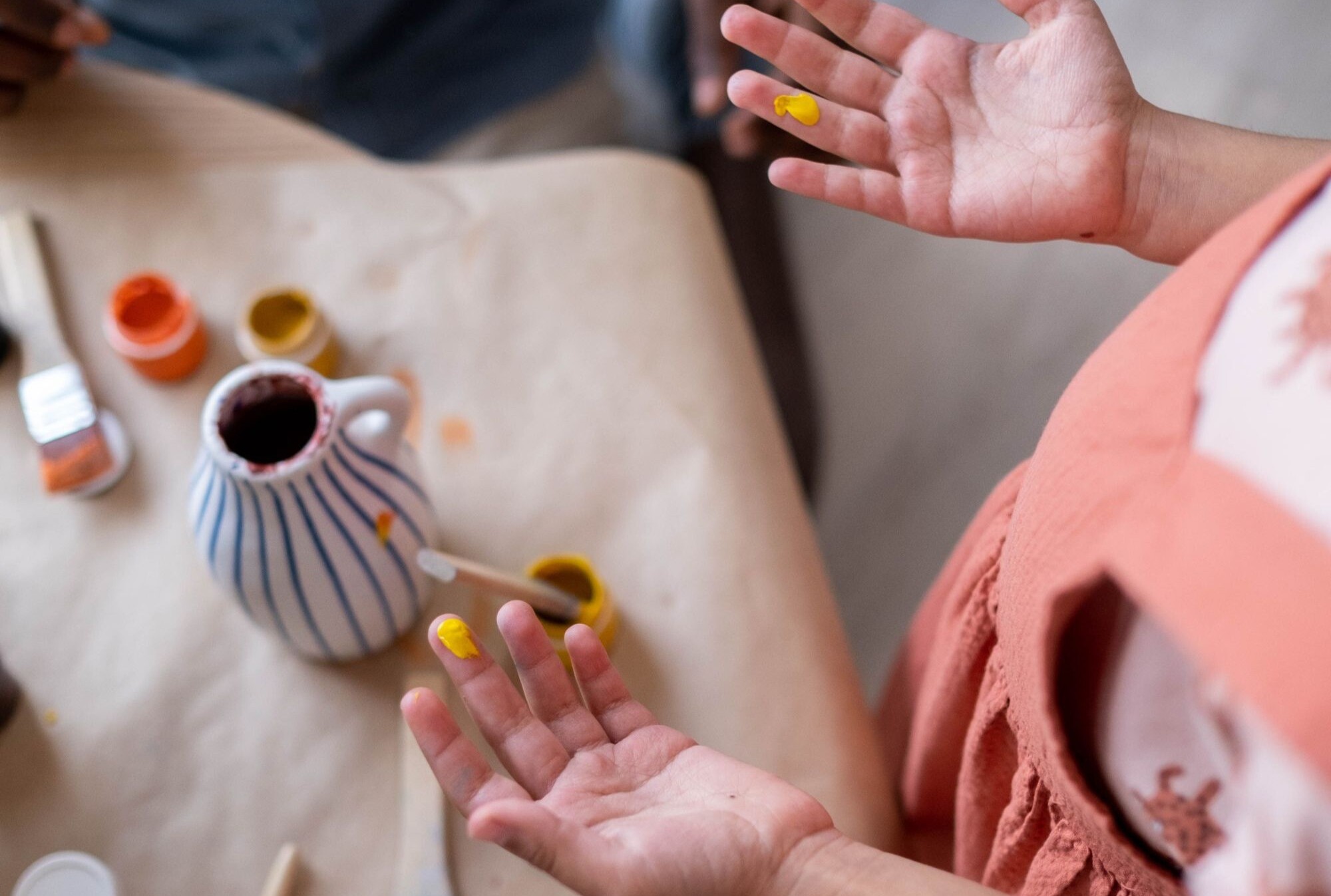
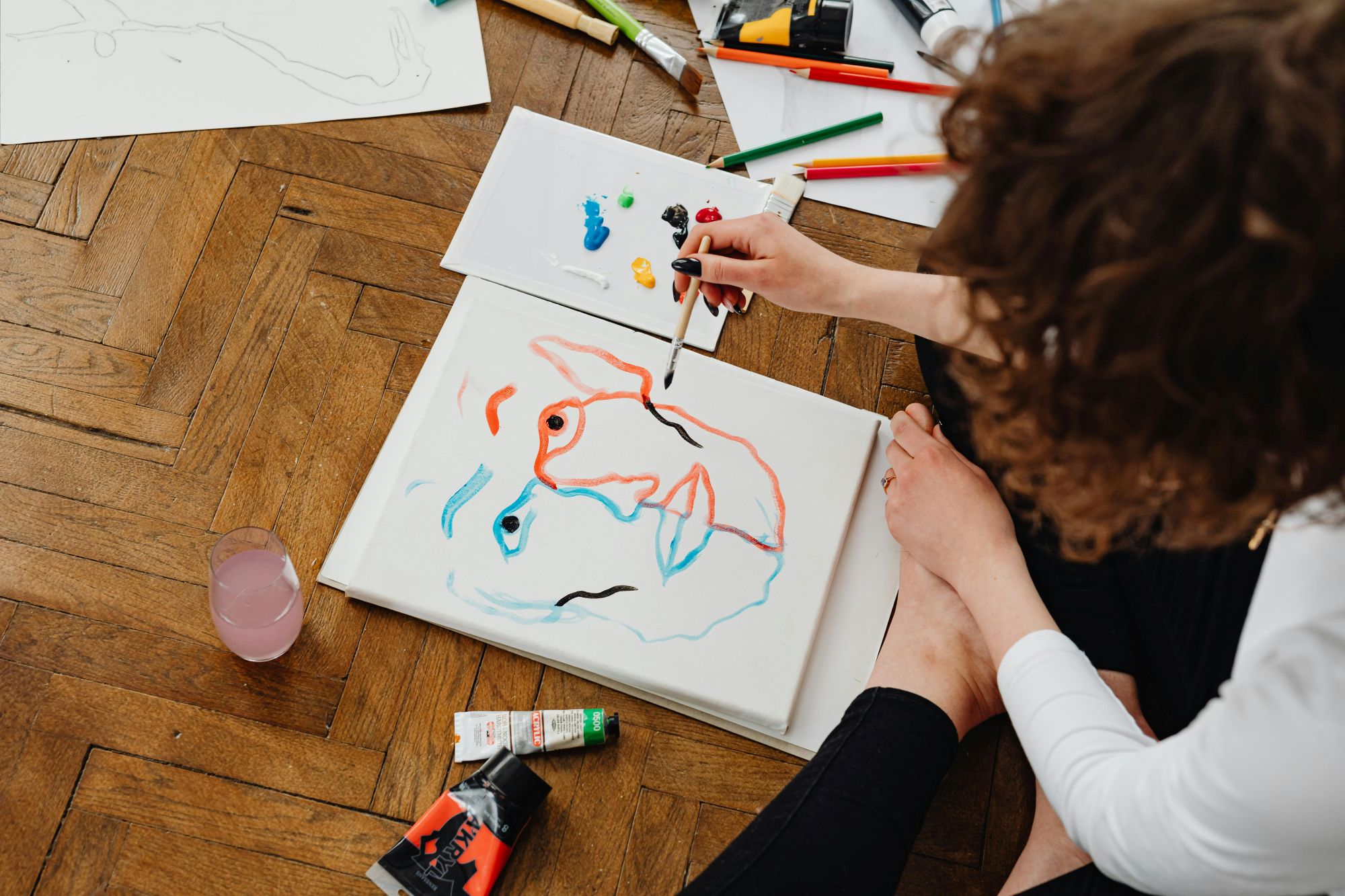
Not an art class. Not colouring-in with a clinical framing. Art therapy is a structured process facilitated by a trained clinician where the creative work — drawing, painting, collage, clay — is the primary medium, not a precursor to the real session. Learn more about how art therapy works and what to expect in our complete guide to art therapy.
What gets made becomes an external object. Something that exists outside the body and can be looked at from a slight distance, changed, built on, occasionally torn up. For anxiety especially that matters, because the feeling that had no shape now has one. Conversations that happen around an object tend to go somewhere different than conversations that happen in the abstract — less circular, less stuck.
What the Research Shows
A 2016 study in the Journal of the American Art Therapy Association found 45 minutes of art-making significantly reduced cortisol levels in participants — regardless of prior artistic experience. The therapeutic effect didn’t depend on making something good. Just making something.
Meta-analyses across anxiety presentations find moderate to significant effect sizes, with stronger results when sessions are facilitated by a trained therapist rather than conducted as self-directed creative activity. Which suggests the clinical relationship is doing something the art alone doesn’t.
The evidence is most consistent for generalised anxiety, social anxiety, and health-related anxiety — the kind that follows serious illness or medical treatment. Lower self-reported anxiety, reduced physiological stress markers, less avoidance behaviour.
Anxiety and Art: Why the Medium Does What It Does
The mechanism isn’t settled. Several explanations have support and are probably all partly right.
Creative engagement activates the brain’s default mode network differently than verbal processing — producing loose, associative thinking that anxious rumination tends to crowd out. The brain occupied with making something is a brain that’s interrupted the loop, at least for a while.
Physically, the materials themselves do something. Pencil pressure, the texture of clay, the rhythm of mark-making — sensory input that regulates arousal in ways a conversation doesn’t. And there’s pace. Anxiety is urgent, driven — there’s a compulsion to resolve the feeling or escape it. Art-making has its own timeline and ignores that urgency entirely. Sitting with something unfinished, not yet knowing what it will become, is exposure to uncertainty. For most anxious people that’s not a side feature of art therapy. It’s close to the centre of it.
Art Therapy and Trauma
Anxiety and trauma often show up as the same problem from different angles. Traumatic memory tends to be encoded in fragments — sensation, image, a particular quality of light — rather than narrative that can be retrieved and discussed. Verbal approaches sometimes reactivate that material without shifting it.
Art therapy and trauma have a well-documented clinical relationship because the creative process approaches things obliquely. Through image and metaphor, at whatever distance the person can currently manage. That indirect contact allows processing that direct narration sometimes forecloses.
Art Therapy for Adults
Most adults arrive with a belief they’re not creative — a teacher’s comment, a sibling who was the artistic one, years of not making anything. That belief sits in the room early on and needs addressing before much else happens.
A good therapist doesn’t reassure. They make clear that skilled work isn’t the point. What gets made doesn’t need to be impressive — it needs to mean something. That reframe takes some people one session. Others longer.
Art therapy for adults is more verbal than work with children, with more explicit conversation woven through sessions about what’s been made. For someone carrying anxiety alongside work, parenting, health demands — it offers a slowing down that isn’t passive. The anxiety has somewhere to go other than back into the body.
Who Art Therapy Is For
Art therapy is available for children, young people, and adults — in-person in Melbourne and online. Presentations that tend to respond well include generalised and social anxiety, trauma and PTSD, grief, and anxiety in neurodivergent adults and young people.
If it sounds like it might be the right fit, book an initial consultation to find out.
Leave A Comment
Type “gaming therapy” into a search engine and the results assume you know what
The session before this one didn’t work. That’s usually how parents end up here
The word “affirming” gets used loosely. In neurodivergent-affirming practice it means something specific —
Talk therapy works. That’s not in dispute — the evidence is solid, the results